The 2025 RAG and AI Agents Bootcamp
Six weeks of live sessions on retrieval-augmented generation and agent systems, taught between 19 July and 31 August 2025 by practitioners from Apple, Thermo Fisher Scientific, ServiceLink, Anterior AI and Lemonaide Music. Free, online, open to anyone who registered.
The NSK AI Foundation exists to put frontier technique in the hands of people who would otherwise pay for it or never see it. The bootcamp was the clearest form of that: the same retrieval and agent engineering our teams do commercially, taught by the people who do it, at no cost, on the record, to anyone who signed up.
Every recording stays public. Nothing taught here is held back from the Foundation’s audience and sold elsewhere.
The Foundation is registered as the Bambara Artificial Intelligence Foundation.
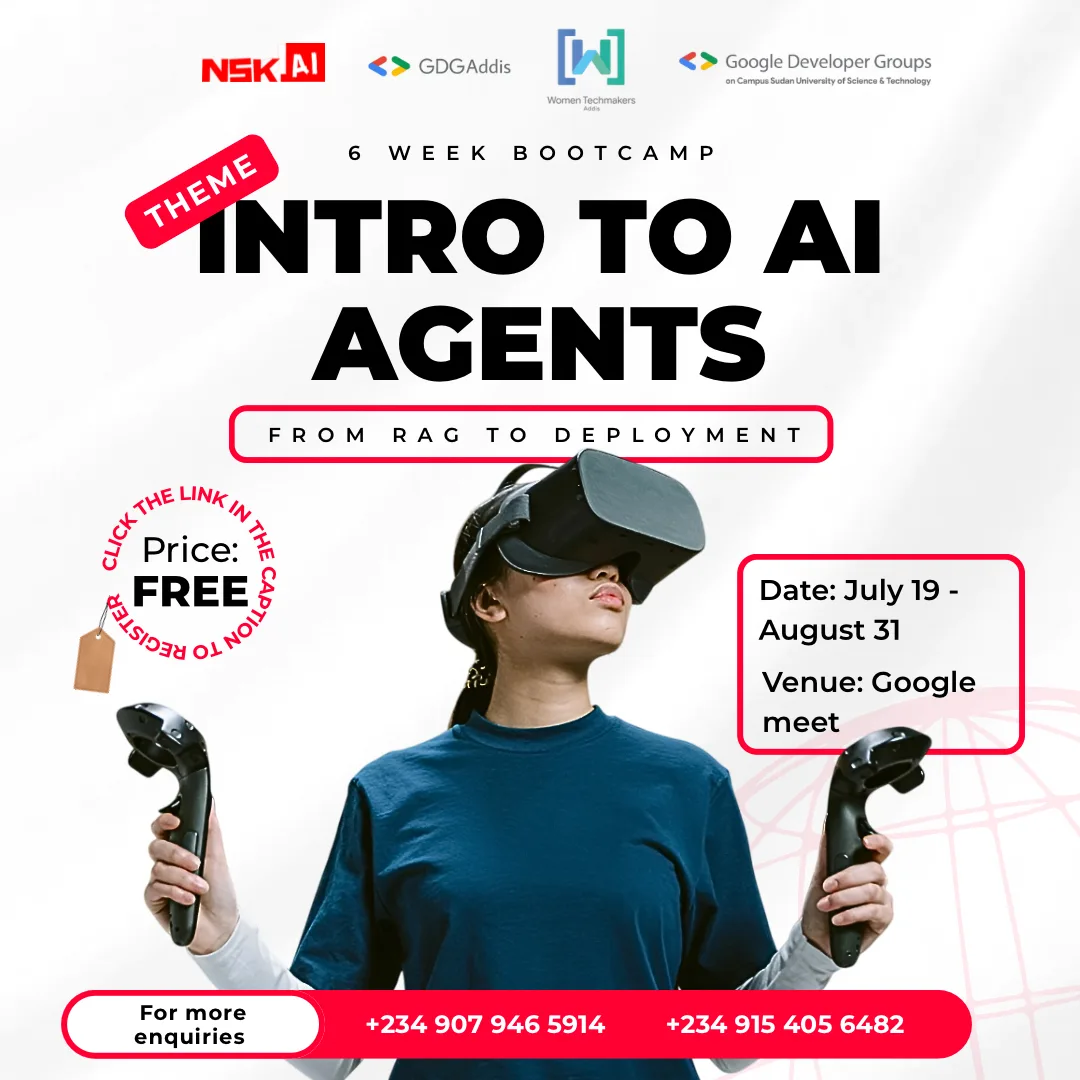
The cohort was organised with three developer communities, which carried the announcement into their own campuses and chapters rather than leaving recruitment to our channels alone.
Registration was open and free, six weeks from 19 July to 31 August 2025, with the theme announced as Intro to AI Agents: from RAG to deployment.
The programme, as it ran
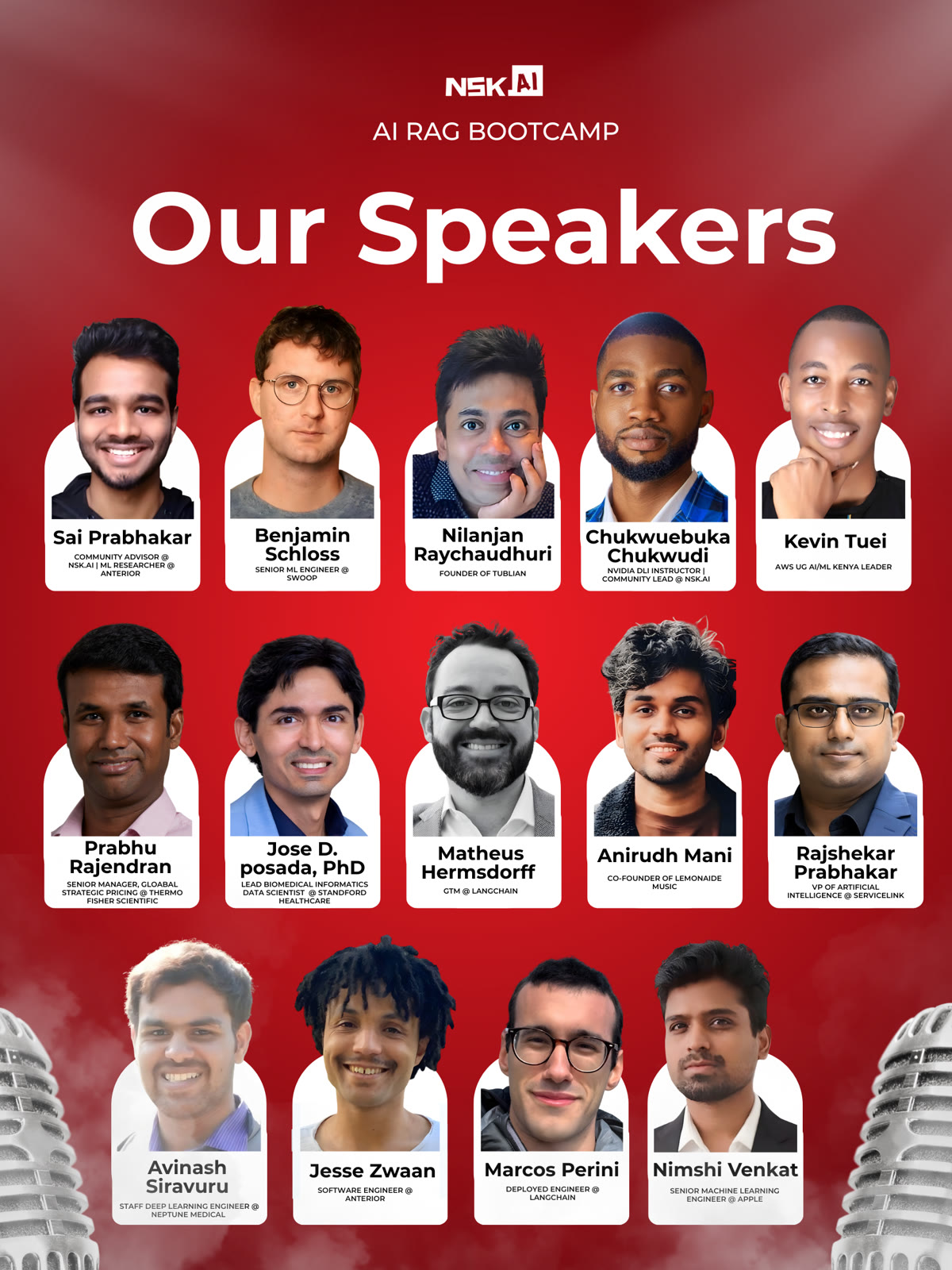
Speakers came from Apple, LangChain, Anterior, Stanford Healthcare, Thermo Fisher Scientific, ServiceLink, Neptune Medical, Swoop, Tublian and Lemonaide Music. None were paid to teach.
A six-person organising team handled curriculum, community, design and the Discord across the six weeks.
Every session was live and recorded, with the recording and materials left public afterwards, so people in timezones that made 6pm WAT impossible were not excluded.
Participants were expected to build rather than watch. They formed their own teams and shipped a product against a closing hackathon, and every team had to draw its members from at least three different countries. That rule was the curriculum as much as the lectures were: nobody finished the cohort having worked only with people they already knew.
What the cohort shipped
Teams were based in Ethiopia, Kenya, Nigeria, Senegal and Chad. Almost none of them built a chatbot for its own sake: the recurring shape was a retrieval system pointed at a document set a public institution had already published but nobody could use — national curricula, tourism records, health guidance, credit policy, government service requirements. Adaptive and self-reflective retrieval, graph retrieval and citation-backed answers appeared across the field, not just in the strongest entries.
Adaptive testing across the Senegalese national curriculum, with difficulty set by performance.
Public service navigator for Kenyan citizens: healthcare, education and NHIF requirements.
Cites the clause behind a credit or regulatory decision, with audit-ready metrics.
Tutoring in six African languages, with progress carried across sessions.
Hybrid graph and vector retrieval over medical sources, with contradiction detection.
Feeding, vaccination and disease guidance for backyard poultry farmers.
Trip planning grounded in official Ethiopian tourism records rather than blogs.
Reads shipment documents, scores delay risk and proposes alternate routes.
Cross-checks a model’s answer against trusted sources before it is shown.
And nine more: Hometown Atlas, CLARIFY, Data Analyzer RAG, SmartCV Chat, NewsAI, CookMate AI, Health-RAG-Chatbot, The Answering Machine, RAG Chatbot for Businesses.
We have one piece of feedback from the 2025 cohort, and it arrived unprompted a year after the sessions ended. Ian Karanja joined while finishing a computer science degree, looking for a way across the gap between coursework and production systems. During the cohort he worked on LifeLine, a navigator for Kenyan public services.
“The bootcamp specifically helped me master the end-to-end process of indexing multi-source data, optimizing vector embeddings, and refining retrieval pipelines to reduce hallucination.”
In the year since, he has built LungScanAI, a system using specialised retrieval pipelines and ensemble analytics over medical data. In his words, the cohort “strips away the fluff and forces you to build real, production-ready RAG architectures and systems that solve high-impact, real-world problems from day one.”
We ran no exit survey. This is the only participant account we hold, and we have not generalised from it.
Six weeks, on the record.
Every session from August 2025 is still public, in full, in the order it was taught.
Watch every session on YouTubeTeach a cohort, or join one.
Instructors, partner institutions and participants all come through the same door.